Features
In this section of the documentation, you will learn how to program in OneVision Scripts, the scripting language used in OneVision.
For information about the scripts in OneVision, refer to Editor.
OneVision Scripts is a specialized computer vision programming language built for the OneVision environment. While it shares many syntactic and functional similarities with TypeScript, it includes specific features to optimize computer vision tasks. With dedicated Vision Elements and Visualization modules, it provides easy access to specialized functions and data types, supports efficient parallel processing, and enables creation of high-quality visuals for industrial applications. This blend of familiar syntax and powerful, synchronous, vision-focused capabilities makes it a strong tool for developing advanced computer vision solutions.
Here are the key features of OneVision Scripts:
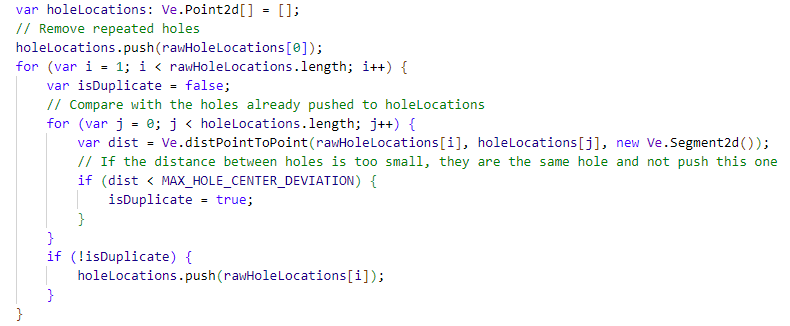
TypeScript-like syntax
- OneVision Scripts uses the same basic syntax for declaring variables and types as TypeScript.
- Function declarations and usage follow TypeScript conventions.
- Familiar control structures such as loops and conditionals are available and follow TypeScript syntax.
Simplified functionality
- To maintain simplicity and focus on computer vision tasks, OneVision Scripts does not support the creation of classes. Instead, it emphasizes functional programming and the use of built-in types, methods and classes. You can create objects from built-in classes, but you cannot define new classes.
- Unlike TypeScript, OneVision Scripts does not support the use of async and await for handling asynchronous operations, streamlining the scripting process for synchronous execution and simplicity.
Enhanced computer vision capabilities
The core of OneVision Scripts' computer vision capabilities is the Vision Elements module. This module contains all the necessary functionality to implement computer vision applications, including:
- Image handling: Methods for loading, processing, and analyzing images.
- Vision-specific data types: Data types specific to computer vision, such as Image, Line, Shape...
- Algorithm Access: Functions to access common computer vision algorithms like edge detection and feature matching.
For the visual representation of the computer vision applications, OneVision has the Visualization module, very useful in the industrial sector.
Optimized performance for vision tasks
OneVision Scripts has built-in support for parallel processing to handle large-scale image data efficiently. This can be achieved using different scripts and function blocks, and running them asynchronously.